

Team Members
Anna Salchner, Anna Theodoulides, Inês Raeiro, Zhiyu Zhao, Kristian Sick, Samantha Conte (Project Leader)
1. Introduction to the project
This project investigates the temporal patterns and rhythms that characterise content consumption on TikTok, with particular attention to how users distribute their interaction sessions throughout the day. Its central aim is to understand when people open the app, how long they remain engaged, and what kinds of content they interact with, in order to identify recurring routines or habits that shape their everyday use of the platform.
The study draws on a dataset of 6 participants from the Algofeed project (see https://algofeed.unimi.it/). For each individual, we combined donated activity traces—specifically likes and favorites—with demographic information and detailed metadata about the videos encountered, including hashtags, creator attributes, descriptions, and broader indicators of engagement. These materials were complemented by a categorisation scheme developed by the Algofeed research team, which assigns each video to a thematic content category.
By following users through their daily interaction sessions, we are able to capture fine-grained variations in behaviour that would remain invisible in aggregate metrics. This session-based perspective makes it possible to distinguish between fleeting, intermittent forms of engagement and more extended periods of immersive browsing, thereby revealing the heterogeneous temporal rhythms that shape TikTok use across different individuals and moments of the day.
2. Research Questions
Main Research Question
How do consumers interact with TikTok content throughout the day?
Sub-questions:
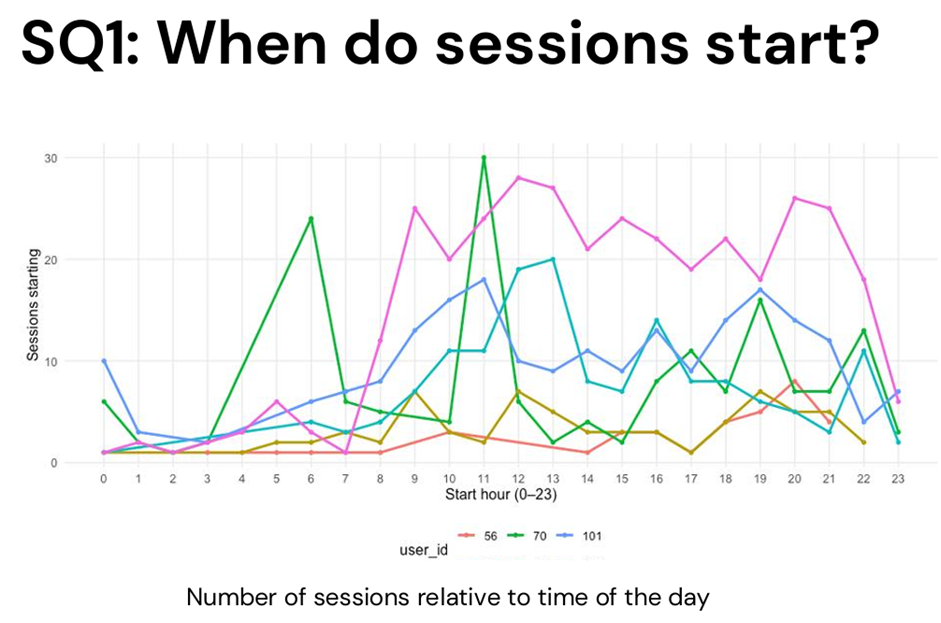
- When do interaction sessions start during the day?
- How long are these sessions?
- What is the nature of these sessions?
- What types of content do users consume?
- What types of interaction do they engage in (likes vs favorites)?
3. Methodology
The methodological design of this study is grounded in a session-based approach that seeks to capture the temporal structure of TikTok use. Rather than analysing individual interactions as isolated events, the study follows users through the unfolding of their sessions across the day. This perspective reflects the assumption, supported by prior research, that platform engagement is shaped by the rhythms of everyday life and that meaningful behavioural patterns emerge only when interactions are understood as part of a broader temporal sequence.
The dataset used in this project is derived from the Algofeed initiative and includes 6 participants who donated detailed records of their TikTok activity. For each user, the data include the moments at which they interacted with videos through likes or favorites, demographic characteristics and a range of metadata describing the content encountered. Each video is also associated with a content category defined through the classification framework developed by the Algofeed research team. These combined materials make it possible to reconstruct not only when users engage with the platform but also what kinds of content they encounter and how they respond to it.
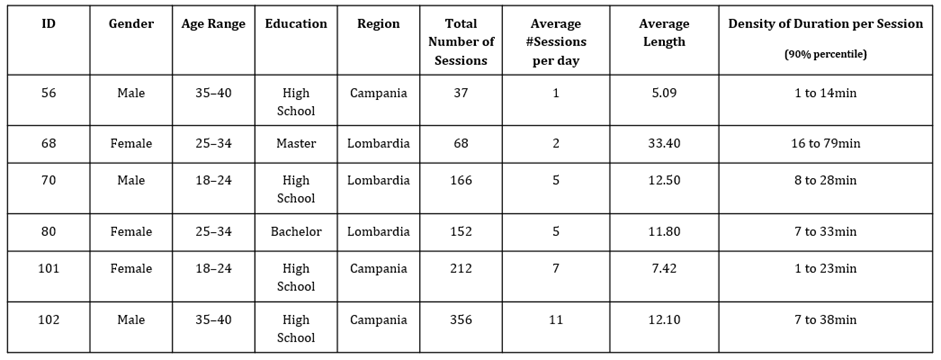
A central aspect of the methodological strategy is the definition and reconstruction of interaction sessions. Sessions follow the temporal logic already embedded in the dataset, which groups interactions that occur without prolonged breaks and resets each day at midnight. By identifying the start time, end time and internal structure of each session, the analysis can trace how long users remain on the platform at different times of the day and how these durations relate to the content they engage with. This session-level view is particularly useful for distinguishing between short, intermittent bursts of activity and more sustained periods of immersive browsing, a distinction that emerges repeatedly in the data.
To examine how content consumption unfolds within and across sessions, the study also incorporates a categorical perspective. Each interaction is linked to one of the content classes defined by the Algofeed team, and these categories are used to explore whether certain types of videos are more prevalent in brief or extended sessions. Furthermore, to understand how thematic interests evolve beyond the session level, the analysis develops category trajectories that summarise the dominant content encountered by each user across consecutive days. These trajectories offer a complementary view of how attention shifts over time and how consistent or variable individual patterns of consumption may be.
The dataset required preliminary preparation before analysis, including the merging of multiple CSV files and the harmonisation of time formats to ensure the reliability of the temporal sequence. Once cleaned and consolidated, the data allowed for a precise reconstruction of users’ daily rhythms of engagement. The relatively small number of participants reflects the exploratory nature of the study, which prioritises depth of temporal insight over statistical generalisability. This scale supports a close examination of individual behaviour while still making it possible to identify recurring patterns across users.
4. Findings
The analysis reveals clear differences in the temporal organisation of TikTok use across the six participants. When looking at the timing of session openings, two behavioural patterns emerge. Some users follow relatively stable temporal routines and tend to open the app at consistent times each day, often aligning with morning breaks, commuting periods or evening settling rituals. Others display a more scattered and continuous pattern of access, returning to the app frequently and irregularly once their day has begun. These contrasting profiles illustrate distinct rhythms of consumption, shaped by personal routines rather than by platform-driven or content-driven cues.
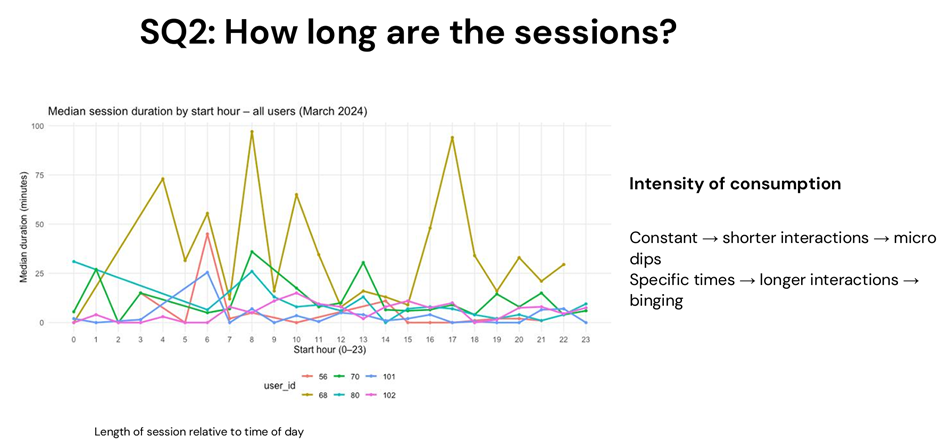
Session length shows a similarly meaningful divide. A number of users engage in very short, highly frequent interactions that function as quick “micro dips” into the platform. Others exhibit longer, more sustained periods of use, often concentrated at specific moments such as late evening hours. Users who open the app repeatedly throughout the day generally experience shorter sessions, while those who engage at particular, predictable times tend to remain on the platform for extended periods, producing what can be described as immersive or binge-like sessions.
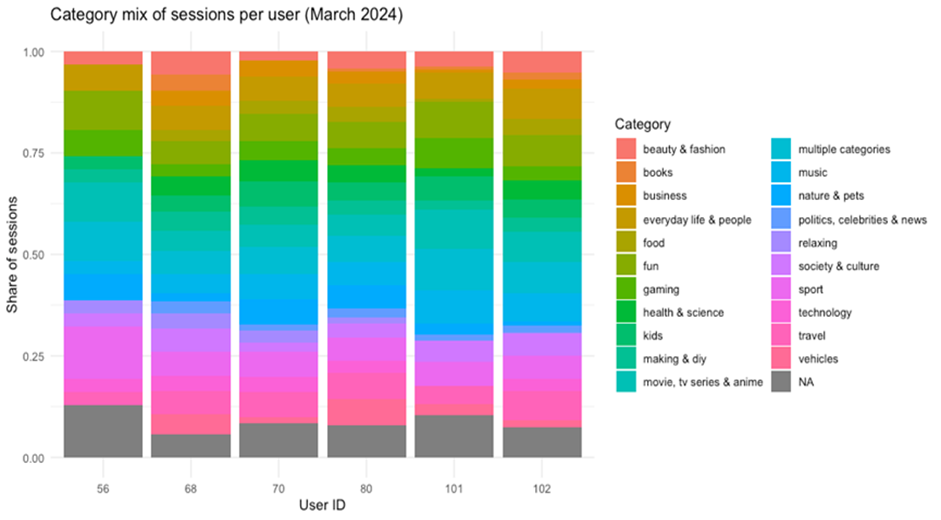
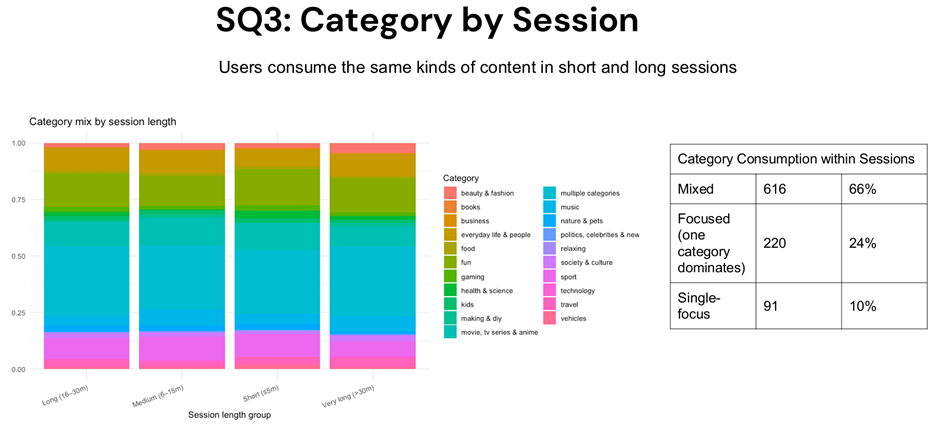
In examining the internal structure of sessions, we find that most of them contain a mixture of content categories: approximately two-thirds involve multiple thematic areas, while only a minority are dominated by a single category. Importantly, the distribution of categories appears relatively stable across both short and long sessions, suggesting that content preferences do not shift substantially with session length.
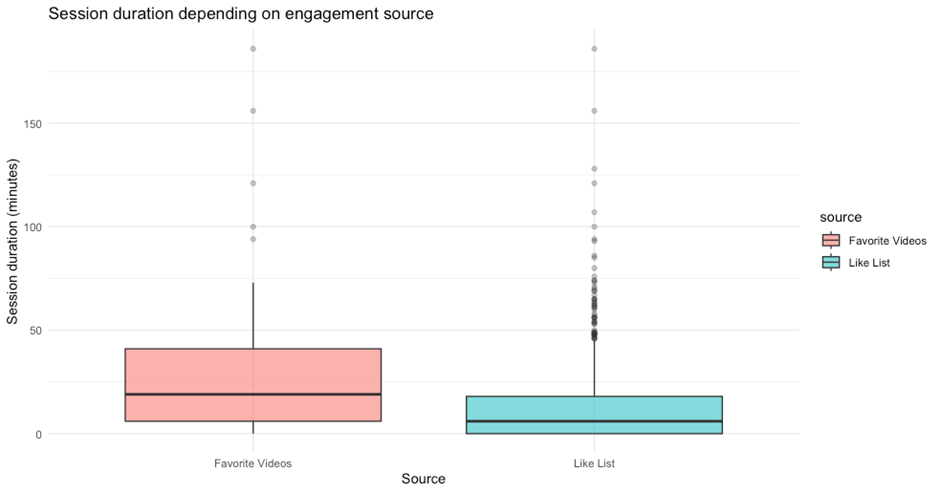
What does differ is the nature of user engagement. Likes are by far the most common form of interaction and tend to occur rapidly, even in the briefest sessions. Favorites are much less frequent, yet when they appear they typically do so within longer sessions and are often surrounded by a cluster of likes. This pattern supports the interpretation that liking functions as a quick acknowledgment, whereas favoriting indicates a more deliberate and meaningful investment in the content.
Finally, the category trajectories constructed for each user reveal the individualised nature of content flows over time. Some participants move fluidly across categories both within and between sessions, creating varied and exploratory pathways. Others adopt more stable patterns, returning repeatedly to central interests such as gaming, movies, beauty or everyday life content. These trajectories capture both the personal stories of attention that unfold across days and the broader structural patterns through which categories are connected in users’ consumption.
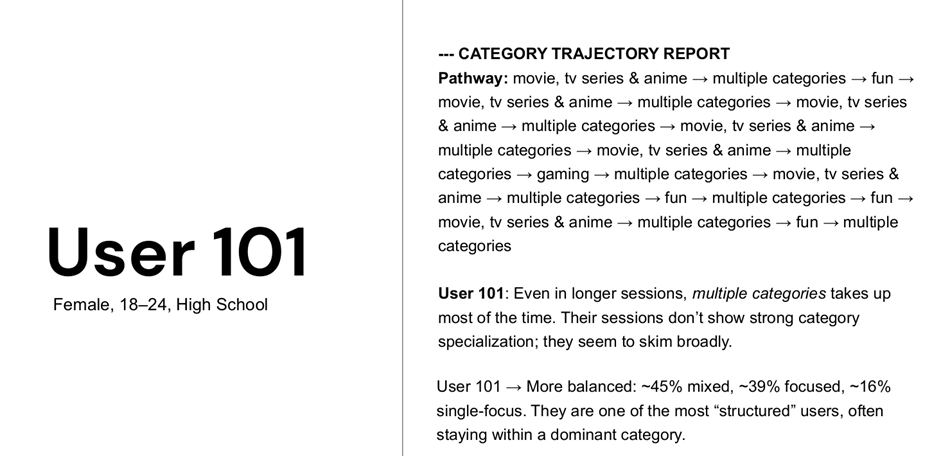
Example of trajectory of consumption (User 101)
5. Discussion
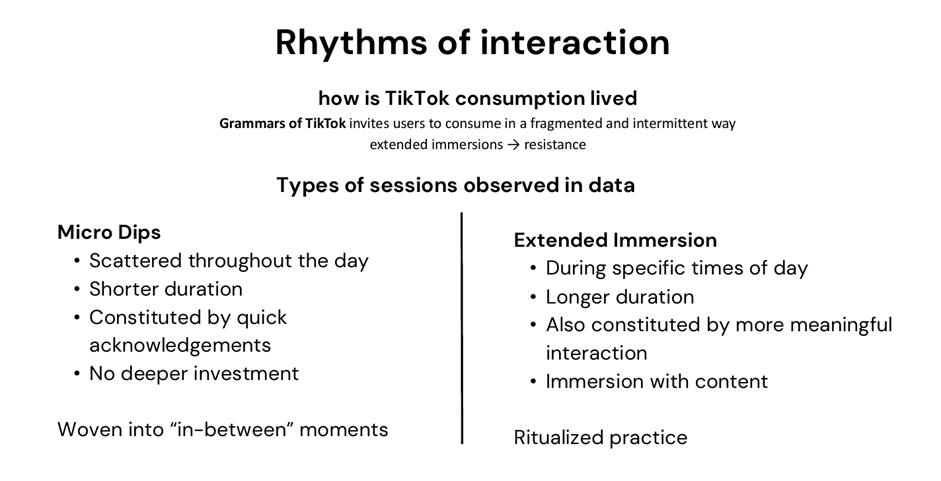
The findings of this study shed light on the ways in which TikTok consumption unfolds across the day and how users weave the platform into the rhythms of everyday life. A central pattern that emerges is the highly fragmented nature of much of the activity. Many users return to the app repeatedly for very brief moments, creating a dispersed experience composed of numerous micro dips. These short interactions suggest that TikTok often occupies transitional spaces within daily routines, filling gaps and accompanying moments of waiting, displacement or mental rest.
Alongside this scattered pattern, the data also reveal a second mode of engagement characterised by longer and more immersive sessions. These extended periods of use tend to cluster at predictable times, especially in the evening, and appear to form part of ritualised practices in which the platform becomes a destination rather than a passing distraction. The coexistence of these two modes underscores the flexibility of TikTok as a medium and the extent to which its use adapts to the rhythms and preferences of individual users rather than being dictated by the content itself.
The analysis of categories confirms this point. Although the dataset covers a wide range of thematic areas—such as Fun, Movies and Anime, Beauty and Fashion, or Everyday Life and People—these categories do not meaningfully shape session length. Users encounter the same types of content in both brief and extended sessions, which suggests that preferences remain stable regardless of how long they stay on the platform. Session duration correlates more strongly with personal routines, time of day and the user’s style of engagement. This pattern points to a homogenising effect of the recommendation feed, where the platform’s continuous content stream encourages fluid movement across categories and limits the degree to which genre or topic structures the temporal dynamics of consumption.
These interpretations must, however, be situated within the constraints of the dataset. The study relies on six users, which inevitably limits the generalisability of the findings and makes it difficult to distinguish individual idiosyncrasies from broader patterns. Moreover, the data do not include contextual details about the circumstances in which browsing occurs, such as concurrent activities or social settings. This absence leaves open questions about how external factors shape session length or timing. Finally, the dataset captures only active forms of engagement. Instances of passive scrolling, where users view content without liking or favoriting, remain unobserved, even though such behaviour may account for a substantial portion of TikTok use. These limitations suggest that the patterns identified here represent only part of a more complex ecology of consumption.
6. Conclusion
The analysis reveals clear differences in the temporal organisation of TikTok use across the six participants. When looking at the timing of session openings, two behavioural patterns emerge. Some users follow relatively stable temporal routines and tend to open the app at consistent times each day, often aligning with morning breaks, commuting periods or evening settling rituals. Others display a more scattered and continuous pattern of access, returning to the app frequently and irregularly once their day has begun. These contrasting profiles illustrate distinct rhythms of consumption, shaped by personal routines rather than by platform-driven or content-driven cues.
Session length shows a similarly meaningful divide. A number of users engage in very short, highly frequent interactions that function as quick “micro dips” into the platform. Others exhibit longer, more sustained periods of use, often concentrated at specific moments such as late evening hours. Users who open the app repeatedly throughout the day generally experience shorter sessions, while those who engage at particular, predictable times tend to remain on the platform for extended periods, producing what can be described as immersive or binge-like sessions.
In examining the internal structure of sessions, we find that most of them contain a mixture of content categories: approximately two-thirds involve multiple thematic areas, while only a minority are dominated by a single category. Importantly, the distribution of categories appears relatively stable across both short and long sessions, suggesting that content preferences do not shift substantially with session length. What does differ is the nature of user engagement. Likes are by far the most common form of interaction and tend to occur rapidly, even in the briefest sessions. Favorites are much less frequent, yet when they appear they typically do so within longer sessions and are often surrounded by a cluster of likes. This pattern supports the interpretation that liking functions as a quick acknowledgment, whereas favoriting indicates a more deliberate and meaningful investment in the content.
Finally, the category trajectories constructed for each user reveal the individualised nature of content flows over time. Some participants move fluidly across categories both within and between sessions, creating varied and exploratory pathways. Others adopt more stable patterns, returning repeatedly to central interests such as gaming, movies, beauty or everyday life content. These trajectories capture both the personal stories of attention that unfold across days and the broader structural patterns through which categories are connected in users’ consumption.
7. References
Algofeed Project, Feedback culture: assessing the effects of algorithmic recommendations on platformized consumption, https://algofeed.unimi.it
Krause, A.E., North, A.C., & Hewitt, L.Y. (2016). The role of location in everyday experiences of music. Psychology of Popular Media Culture, 5(3), 232–257. https://doi.org/10.1037/ppm0000059
Shakespeare, D. & Roth, C. (2025). Tracing Affordance and Item Adoption on Music Streaming Platforms. arXiv. https://doi.org/10.48550/arXiv.2109.03538 2